How to Get So Good at Valorant It Feels Like Smurfing
You can order the same kind of articles for your own video to boost it on YouTube and Google. Just message the Telegram bot @sat_sit_bot. It writes articles around your video, embeds the video and publishes them on popular niche websites (no ads). Try it free: 50 articles on us.
Smurfing in Valorant is not a secret technique — it is what happens when a player reacts faster, moves better and makes simpler decisions than everyone else in the lobby. To get so good at Valorant that it feels like smurfing, you stop playing a script and start reacting to what the enemy actually does, round after round. Coach Konpeki breaks this down in the video "How to Get So Good at Valorant it Feels Like Smurfing" and offers a structured route through his Immortal Roadmap Program at roadmap.gg/v/lUfrMRb74SE, where the promise is five divisions in ten weeks.
The uncomfortable truth is that most players are not losing because their aim is bad. They are losing because their brain is one step behind the fight. A smurf looks like a smurf because the duel is already decided before the first bullet leaves the barrel.
Why Smurfs Look So Much Faster Than You
A smurf is not reading your mind — they are reading your habits. Every ranked lobby runs on patterns: the same default push on attack, the same anchor position on defense, the same timing on a retake. A player who has seen those patterns a thousand times does not need to think about them, so all of their attention goes to the one thing that actually changed this round.
That is why the gap feels so large. It is not a 20% aim difference. It is a difference in how much of the fight is already solved before it starts. If you want to close that gap, you have to attack the decision layer first and the mechanics second, because mechanics without decisions just means you lose the duel faster.
React to the Enemy Instead of Running a Script
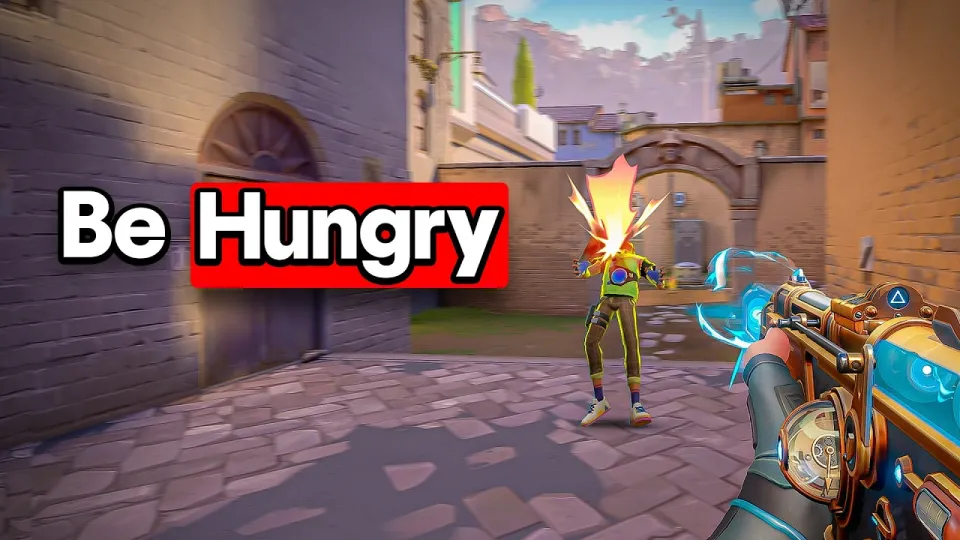
The single most repeated idea around this topic, and the one viewers keep summarising in the comments, is simple: react to the enemy and stay unpredictable. That sounds obvious, but almost nobody actually does it.
- Before the round starts, name one thing you expect the enemy to do — a fast push, a default, a lurk.
- Play your first contact in a way that punishes that expectation, not in a way that assumes it.
- The moment the enemy does something else, drop the plan. Your utility, your position and your timing should all be adjustable within the first ten seconds.
A scripted player dies to the second thing the enemy tries. A reactive player forces the enemy to keep guessing, and guessing costs them time — time you use to take space or rotate first.
Movement Discipline Is the Real Aim Trainer
Movement is where most mid-elo players quietly lose their duels. They peek, they shoot while strafing, and they wonder why the crosshair never lands where they expect. In Valorant, accuracy while moving is heavily punished, so the shot has to happen in the tiny window where your character is standing still.
Counter-strafing is the fix. Tap the opposite direction key for a fraction of a second to kill your momentum, then fire. Done properly, your character is stationary at the exact moment you click, and your first bullet goes where the crosshair is. One viewer suggested turning on the movement error graph in the range and setting its multiplier to 0.5, which is a genuinely useful way to see how much accuracy you are throwing away every time you shoot mid-strafe.
Pair that with a range routine: strafe left, stop, one tap, strafe right, stop, one tap. Do it slowly enough that every shot is clean, then speed up only when the accuracy holds. Speed is a byproduct of consistency, never the other way around.
Make Your Ranked Games Boringly Simple
High-level Valorant looks complicated on stream and is extremely simple in practice. The best players reduce each round to a short plan: who takes space, who holds the flank, what utility opens the site, and where the team plays after the plant. Everything else is noise.
A useful exercise is to write your round plan in one sentence before the buy phase ends. If you cannot say it in one sentence, the plan is too complicated and will fall apart on first contact. This is the same principle that applies in any sport: the fundamentals are boring, and the boring stuff is what wins.
Simplicity also protects you from tilt. When a round goes wrong, you are not debugging a ten-step strategy — you are checking whether you followed the one sentence you wrote.
Stop Chasing the Highlight Play
The fastest way to look like a smurf is to stop trying to look like one. Flashy plays are the result of a good decision landing in a good situation, not the cause of it. Players who hunt highlights take low-percentage fights, and low-percentage fights are exactly what keeps them stuck.
Instead, build a small set of repeatable wins:
- Take the free duel when the enemy makes a mistake.
- Trade your teammate instead of letting them die alone.
- Play your life when the round is already won.
- Save your utility for the retake instead of dumping it on entry.
None of these generate clips. All of them generate rank.
Common Questions From Players Trying to Improve
The questions that come up most often around this kind of coaching are about whether it works on console, whether there is an age requirement, and whether the advice is just the same recycled content. On console, the fundamentals are identical — reaction speed, movement discipline and simple plans transfer directly, only the input changes. Age is not the barrier people assume; consistency is. And the reason the advice sounds familiar is that fundamentals do not change, they only get executed better.
The other recurring theme is teammates. You cannot fix a lobby full of players who do not want to coordinate, but you can control whether you are the reliable player on the team. Being the person who trades, communicates and plays the objective is worth more RR over a season than any single mechanical upgrade.
Useful Links
- Immortal Roadmap Program application: https://roadmap.gg/v/lUfrMRb74SE
- Free coaching resources and office hours on Discord: https://www.discord.gg/UnRETVmRpV
- Twitch: https://www.twitch.tv/konpekichan
- Twitter: https://twitter.com/coachpeki
- TikTok: https://www.tiktok.com/@coachpeki
Final Thoughts on Playing Above Your Rank
Getting so good at Valorant that it feels like smurfing comes down to a small number of habits repeated until they are automatic: react instead of scripting, stop before you shoot, keep the round plan to one sentence, and take the fights the enemy gives you rather than the ones you force. None of these require a new sensitivity or a better mouse. They require you to slow down the decision and speed up the execution.
Konpeki's breakdown is a useful starting point because it treats ranked like a sport rather than a highlight reel, and the coaching behind it is built around repetition instead of theory. If you want the structured version, the Immortal Roadmap Program is where that path is laid out.
Key takeaways
- Smurfing isn't a hack — it's the gap between automatic reactions and slow, planned decisions.
- The core habit: react to what the enemy actually does instead of running a pre-set script.
- Movement discipline (counter-strafing, stopping before you shoot) wins more duels than raw aim.
- Unpredictability beats perfect mechanics: mix timings, angles and positions every round.
- A one-page round plan keeps ranked games simple the way real sports stay simple.
Questions & answers
How long does it take to actually feel like a smurf in Valorant?
It depends on how many of your current habits are automatic rather than deliberate. Most players see a visible jump in a few weeks of focused practice on reaction speed, counter-strafing and simple round plans, because those three things affect every single duel. Mechanical improvement is slower, but decision improvement shows up almost immediately in your win rate.
Do I need high sensitivity or a specific crosshair to play like a smurf?
No. Settings are personal and almost never the reason someone is stuck. What matters is that your crosshair placement is at head level before the fight starts and that you stop moving before you shoot. A player with average settings and disciplined movement beats a player with perfect settings who shoots mid-strafe.
Does this approach work for console players?
Yes. The fundamentals are input-agnostic: reacting to the enemy instead of running a script, keeping your movement clean, and simplifying your round plan all apply on PS5 or Xbox exactly as they do on PC. Only the aim mechanics differ, so expect to spend more time on controller-specific movement drills.
Is there an age requirement to join the coaching program?
That is a question viewers ask often, and the honest answer is that it depends on the program's own terms rather than on your rank or skill level. The best move is to check the application page directly and ask before committing, since the program is built around a fixed schedule and limited slots.
Source: How to Get So Good at Valorant it Feels Like Smurfing · Markdown version